All About Learning Press

Programs that teach thoroughly, so your child can succeed amazingly

A while back I wrote a post about how I was a little frustrated by my two-year-old twins’ reading habits, and how they simply weren’t conforming to Mamma’s dreamy-snuggly version of what story time should be.

I’m happy to report that now, several months later…not so much has changed. Why happy? Because their little personalities are really beginning to emerge, and it’s been fun to see how their interests diverge and meet.

While reorganizing their books recently, it dawned on me that I could chart their reading progress in terms of ages, like in prehistory or something.

First, there was the Book-Eaters Age. Archeological exploration revealed fossils of half-chewed board books and coverless specimens held together by the decaying remains of transparent packing tape.

The Book-Eater Age

Then came the Classics Age, marked by the twins’ complete refusal to have anything whatsoever to do with classic books I was led to understand that every child in every corner of the earth would ask for every night of their lives from birth until I wanted to hurl said books from the nearest cliff. Nope. These books are in pristine condition, with nary a tiny fingerprint or spot of drool to mar them.

The Classics Age

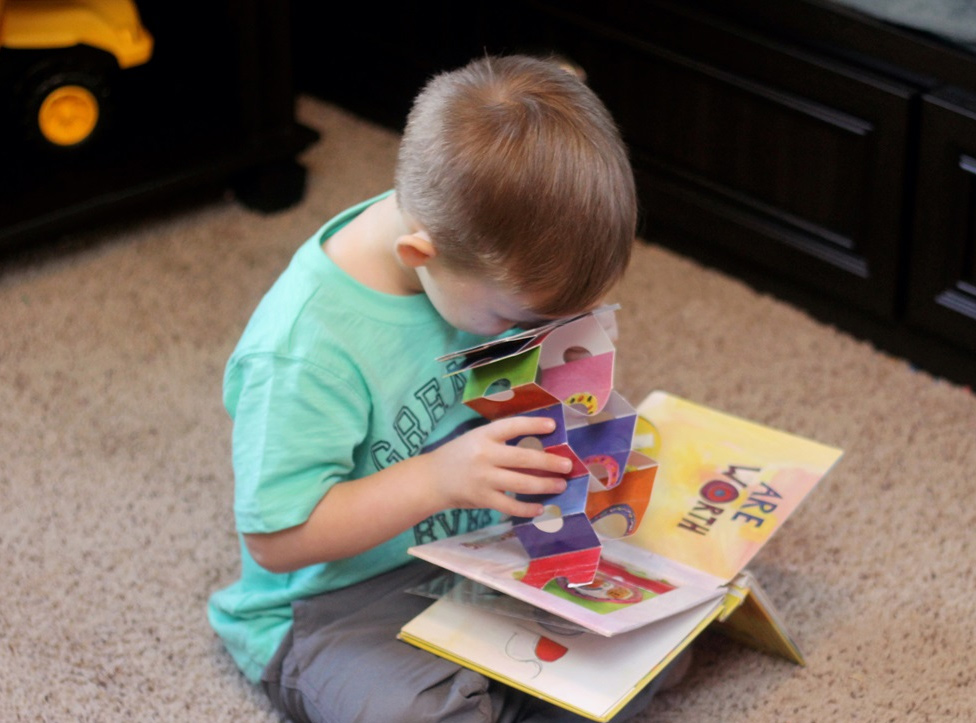
Next came the popular Gotta Have a Gimmick Age, which, judging by the state of the relics uncovered, enjoyed more success than previous ages. These specimens had noise buttons for quacking and snoring, tabs to push and pull, sparkly raised insects to touch, puzzle pieces to arrange, and even music that played at the touch of a button…

Gotta Have a Gimmick Age

…even if it seems early inhabitants might have taken the phrase “lift the flap” a bit too literally.

Lift the flap...but not that much

And finally there was the All the Rage Age, marked by a parent’s willy-nilly desire to build a library of all the most popular contemporary picture books. These are all gorgeous and wonderful and rich and funny…and to date have been read by only one person, who happens to be taller than a two-year-old.

The All the Rage Age

Every night, when the boys point to this lovely stack of books, I hold up new titles with a lilt in my voice and a hopeful look in my eyes.

Ooh, you want to read about the sad fish?

Son 1: No. Muh, muh…
Son 2: No. Shebbah dado ohhhh…

Oh, the kitty and birdie!

Son 1: No! Muh muh muh muh….
Son 2: Noooo…ooo….shebbah dadooooo…

Look, it’s a bear with a hat!

Son 1: No, no, Mamma, muh muh…!
Son 2: Mamma! Shebbah dadooooo…ohhhhh….!

Sigh.

It’s Moon and Sheep once more; to each his own. We are smack dab in the middle of Again and Again Age, when Moon will lose his shoe every single night and Sheep will not be able to sleep ever, ever again. (At least their reading choices are from the beautiful books in the crossover All the Rage Age!)

The Age of Again and Again

During this age, which I suspect will last a good long while, I will continue to exclaim enthusiastically about every detail of every page in two books simultaneously, showing how to turn pages with the least amount of mangling, keeping vigilance over the drool factor to minimize water damage.

Of course, I am glad the boys know their own minds and have their favorites. But still I wonder when we will enter the New Horizons Age, when we can leave old friends behind now and then and make new ones from among the fish and owls and cows, and yes even boys and girls, who are waiting patiently in my beloved pile of picture books.

What about you? What “Reading Age” are your children in? Do you follow your kids’ leads on reading material, or do you require that they read certain books…or do you manage a combination of both?


Let the games begin! Adventures in Reading with the Zigzag Zebra is here! (And it’s on sale for $16.95 for one week only, through April 9!)

We’ve heard More Ziggy, please! on a daily basis, so I’m excited to share this beautiful book with you!  This is a supplement to Level 1 of the All About Reading series, and it’s a fun way to provide additional practice for your beginning reader.

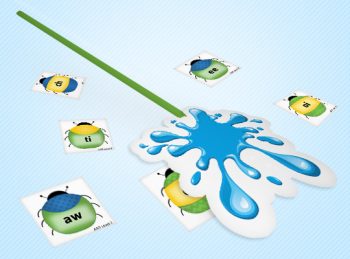
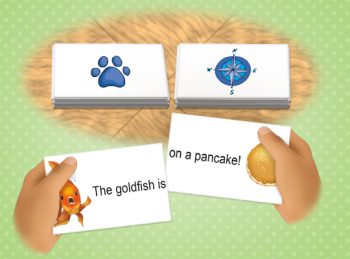
Here is the “Blast Off with Ziggy” game from the book. You simply remove the perforated game pages and paste them into your own file folder.

To play, choose your game piece.

If you need an extra player, Ziggy is always a willing participant. The Zigzag Zebra is already a familiar face to users of our pre-reading program, but if you’re just meeting Ziggy for the first time, you’ll soon discover that he is a young zebra who is learning to read right along with your student. He is a supportive friend for beginning readers, and he likes to have a good time as he learns. And if you don’t own our plush Ziggy puppet, don’t despair! We’ve included a paper Ziggy in the book, and you can paste his likeness onto a file folder and prop him up to play along.

When you are done playing, store the instructions and game pieces in the front pocket that is included in the book.

It’s pretty cool: Ziggy travels to each continent and practices his reading skills. Here he is teaching sheep in New Zealand how to read.

And here Ziggy goes to the beach in Cape Town, South Africa.

Other destinations include Paris, a Caribbean island, Mongolia, and the South Pole. The book includes a map so your child can keep track of the places visited.

You can store your reading games in a file drawer, between two bookends on a book shelf, or in a plastic storage bin. Your kids will want to take them out again and again!

Have you ever used games and reading activities to motivate or teach your beginning reader? Please share in the comments below! We can all learn from each other!

Permanent learning is a common theme here at All About Learning Press. When you take the time to teach your child something, you want it to stick. You want to make a difference. You want them to remember the concepts years from now.

Today I went to visit Ginger, a darling pony mare I used to own. I haven’t played with Ginger in about a year, but she remembered everything we used to do together, in spite of the fact that she hasn’t done any of her tricks since last spring.

Our Spanish walk…

Ginger and Marie - Spanish Walk 2

Read On »

Imagine that a teacher brings to her class a bag of flour, a packet of yeast, a bowl of tomato sauce, and various piles of cheese, sausage, and dried herbs.

She unceremoniously dumps the food on an empty desk in the front of the room. All the ingredients are wholesome, but her students know that they are expected to eat that mess, and they aren’t looking forward to it. Can you blame them?

Pizza Ingredients

Now picture a different scenario.

Read On »

WhippetAccording to experts, the average dog knows approximately 160 words. My previous experience with family dogs (a clever and fun-loving Australian Shepherd and an ultra-intelligent and bossy Welsh Corgi) easily supported that figure. Then one day, along came Gracie the Whippet puppy. She arrived with boundless puppy energy, an enormous wellspring of love to share, and a vocabulary consisting of—nothing!

It was a bit unexpected to realize that our bright and vivacious puppy did not recognize even the simplest of words. During her first two days with us, we attempted to find some grounds of verbal communication with her. “Come, Gracie, come,” yielded a blank stare and a bit of a tail wag. “Go outside? Go for a walk?” No reaction. We tried a slew of food words, looking for something that she recognized: “Are you hungry? Eat? Dinner? Cookie? Treat?” All of these words resulted in the same uninterested gaze.

Read On »

A special note on an online order caught our attention recently, and it made us stop and smile. The request was simple enough, although slightly out of the ordinary:

“Draw an elephant riding a skateboard on the package.” –Kyle in NC.

Read On »

When I was a little girl, I loved my doll and always drifted lovingly off to sleep with her in my arms. But time after time I would awake with no doll safely in my bed; she was instead flung across my bedroom. I tried so hard to be a good mommy to my doll, but it never worked out—I continued to toss my doll out of my bed every night while I was asleep. In the end, I just gave up trying to sleep with her. This was my childhood experience with dolls.

Read On »

I love words and still make a conscious effort to build my vocabulary, adding delectable new words whenever I come across them. But I recently learned that a large vocabulary isn’t always necessary when it comes to getting your point across.

First you need to know that I live in the woods and I love to explore. Leafy green forests full of shadows and light just captivate me. So it was no surprise that when I came across an intriguing little path through the trees on an old river road, I wandered down it, full of curiosity.

Read On »

I wrote my first poem at the age of seven. Here it is:

Whale in the sea
whale in the sea…
I see something else!
Oh, what could it be?
A starfish? A jellyfish?
Oh, what could it be!

I was lying on my stomach in my dad’s recliner, legs bent up the back, elbows on the footrest, tummy sticking to the black vinyl in the heat of a summer night. At the table behind me were my parents and some friends, gabbing over a game of cards. And there I was, eyes narrowed at my paper, chewing on my eraser.

Read On »