
Search
A great technique for preventing spelling errors is called “Pronounce for Spelling.”
When you pronounce for spelling, you exaggerate the pronunciation of a word to make it easier to spell. For example, in casual speech we often pronounce the word different as difrent, leaving out the second syllable. When we pronounce for spelling, we carefully enunciate each syllable (dif-fer-ent), making it much easier to spell. Watch this video for a demonstration.
Let’s dive deeper. Let’s say your child writes a sentence like this:

When viewed on paper, the sentence obviously contains several misspelled words. And yet when you read the sentence aloud, exactly as written, you realize your child has spelled the words exactly the way she pronounces them.
If your child mispronounces a word, it can make it difficult for her to correctly spell the word. On the other hand, if she learns to pronounce a word clearly and correctly, she has a much greater chance of being able to spell it correctly, too. Many words are commonly mispronounced and misspelled, including probably (probly), secretary (secertary), because (becuz), and library (libary).
Here are three things that cause pronunciation pitfalls.
Some words are not pronounced clearly in everyday speech. For example, most Americans pronounce the word button as butn. The vowel sound in the unaccented syllable gets lost in the normal rhythm of speech, something that is particularly noticeable in words like different (difrent), separate (seprit), and jewelry (jewlry).

| How It’s Spelled | How It’s Often Pronounced |
|---|---|
| different | dif-rent |
| separate | sep-rit |
| jewelry | jewl-ry |
| chocolate | choc-lit |
| camera | cam-ra |
| interest | in-trest |
| several | sev-ral |
The variance of regional accents can also make certain words more challenging to spell. For instance, these word pairs are pronounced alike in some regions:
than/then we’re/were cot/caught don/dawn collar/caller wok/walk
feel/fill stock/stalk sense/since been/bean trail/trial marry/merry
The “pin-pen merger” is a prime example of regional pronunciation that causes different words to sound the same. In many areas of the southern United States, the words pin and pen are pronounced identically. This can cause confusion for children who are learning to spell; the words represent two completely different vowel sounds, but they are not pronounced to reflect that. Other similar word pairs include him-hem and kin-Ken. For specific help with these words, be sure to check out 6 Tips to Help Distinguish Between Short I and Short E.
Many words in the English language are derived from Latin or Greek root words or have been borrowed from other languages. This has resulted in many English words with letters that we no longer pronounce.
Hover over or click the words below to see the unpronounced letters.

| honest | Wednesday |
| muscle | knuckle |
| handkerchief | lamb |
| scissors | design |
| friend | thistle |
So between unaccented syllables, regional accents, and silent letters, what’s a spelling teacher to do?
As our emu friend demonstrated in the video, there are two simple steps to the Pronounce for Spelling technique.
Exaggerating the pronunciation of hard-to-spell words allows you to hear each sound clearly, making it much easier to spell the words.
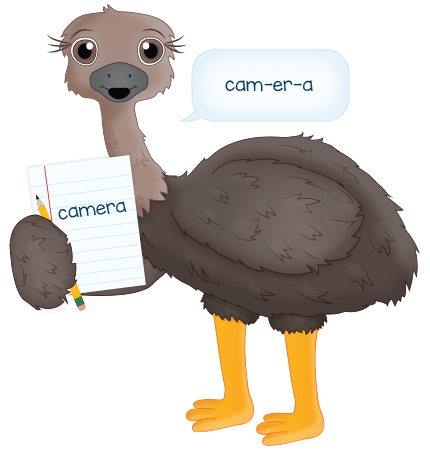
If your student isn’t aware of the correct pronunciation, model it for him. For example, if he regularly pronounces camera as camra, carefully pronounce the word for him: cam-er-a. When he can hear each syllable, he’ll be less likely to gloss over the unaccented syllables.
Notice that the first step in this technique is to exaggerate the pronunciation of the word. We’re not advocating that your child go around saying camera with ultraprecision—just during spelling lessons.
Now there will be times that “pronounce for spelling” won’t work. Take the word could, for example, where the silent L can’t be pronounced. In these cases, we throw the word in jail. Curious what that means? Read this post to find out exactly how we throw words in jail and to get your own jail for spelling words!
It can be endearing when children mispronounce words—aminals for animals or pasghetti for spaghetti. Their early attempts can make us smile.
At this stage, it isn’t necessary to interrupt a child to correct his pronunciation. It’s more important to keep a positive environment for speaking and communicating.
The best method for helping a child’s pronunciation is through purposeful modeling. If your child says, “I’d like some more pasgetti,” you could respond, “More spaghetti, coming up!” If your child talks about an ambliance whizzing past your car, you could say, “The ambulance must be headed to the hospital.” These are gentle, almost invisible, corrections.
But young children aren’t the only ones who pronounce words incorrectly.
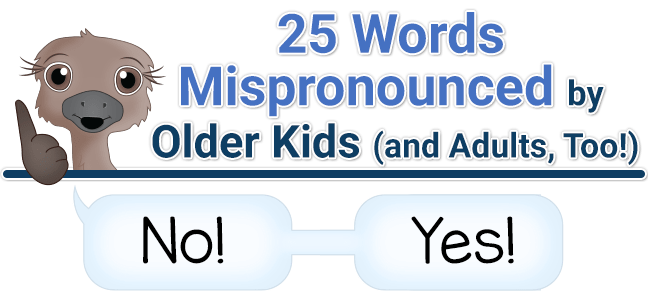
Check out this list of common words that are easier to spell when they are pronounced correctly. Click the audio icons below to hear the correct pronunciation of each word. (Note: if a word has more than one accepted pronunciation, the most common pronunciation is given.)
| “perscription” | prescription |
| “goverment” | government |
| “artic” | arctic |
| “athelete” | athlete |
| “excape” | escape |
| “expresso” | espresso |
| “canidate” | candidate |
| “pacific” | specific |
| “triathalon” | triathlon |
| “bob wire” | barbed wire |
| “crect” | correct |
| “probly” or “prolly” | probably |
| “close” | clothes |
| “dialate” | dilate |
| “excetera” | et cetera |
| “Febry” | February |
| “fedral” | federal |
| “foilage” or “foe-lage” | foliage |
| “heighth” | height |
| “jewlery” | jewelry |
| “histry” | history |
| “mannaise” | mayonnaise |
| “pronounciation” | pronunciation |
| “realator” | realtor |
| “supposably” | supposedly |
And then there is the issue of relaxed pronunciation, where we blend two or more words together in casual speech.

| Blended phrase | Interpretation |
|---|---|
| acoupla (as in, I’d love to have acoupla goats.) | a couple of |
| algo (as in, Algo if you go.) | I’ll go |
| a lotta (as in, I ate a lotta spaghetti.) | a lot of |
| betcha (as in, I’ll betcha a dollar.) | bet you |
| awayzaway (as in, Our vacation is awayzaway.) | a ways away |
| c’mere (as in, Can you c’mere for a minute?) | come here |
| ‘cuz (as in, I dropped it ‘cuz it was hot.) | because |
| d’wanna (as in, D’wanna go to the park?) | do you want to |
| hafta (as in, I hafta go to the store.) | have to |
| howzat (as in, Howzat book you’re reading?) | how is that |
| kinda (as in, We stayed up kinda late.) | kind of |
| omina (as in, Omina show you something.) | I’m going to |
| sko (as in, Sko to the beach!) | let’s go |
| toldja (as in, Toldja he wouldn’t like it!) | told you |
| don’tcha (as in, Don’tcha want to come with me?) | don’t you |
| whaddya (as in, Whaddya mean?) | what do you |
| yoosta (as in, I yoosta be good at playing piano.) | used to |
| spozed-ta (as in, You’re spozed-ta be there early.) | supposed to |
Here are technical words to describe how words can change in casual speech:
Most of us do change words when we speak, but in spelling class it is helpful to slow down and pronounce the words clearly to reduce the chances of misspelling them.
Any time your student fergets how to spell a word, simply remind him not to forget to “pronounce for spelling.”
By taking the time to thoughtfully consider every part of the word, he will be able to clearly enunciate each syllable, thus increasing his chances of spelling the word correctly.
Is there a word that your child has trouble spelling because of a pronunciation problem? Let me know in the comments below.



Kristy
says:I’m teaching my 6 year old the short sounds of (i) and (e). Do you have any suggestions for words like Ben and hen that are spelled with (e) but sounds like (i)?
Robin
says: Customer ServiceWe do, Kristy! This issue is common enough that we have a whole article on it. Check out 6 Tips to Help Distinguish Between Short I and Short E!
Kathy
says:Hi!
I’m wondering if the word problem in phonetic spelling for correct pronounciation “prahb-l’m – with syllablic M?
Robin
says: Customer ServiceKathy,
I find it frustrating but a bit funny that the word problem is often the first word students have problem with in regard to the need to pronounce for spelling!
To learn to spell the word problem correctly, students need to learn to pronounce for spelling it according to the vowels it has. So prob – lem, with clear short O and short E sounds.
One of the very early rules that All About Spelling teaches is that every syllable must have a vowel. So, by the time students get to the word problem, they will know that they can’t spell the second syllable without one. But with most regional accents with this word, the vowel sound most will hear in the second syllable is short U or a /uh/ or /ih/ (schwa) sound. Learning to pronounce for spelling with a clear short E sound removes the tendency to use a U in the second syllable.
I hope this helps! Let me know if you have additional questions or need anything else.
Nana Bett
says:Jewellery is the correct spelling. Otherwise, a great article. I try to get my granddaughter, who’s 5, to pronounce correctly, but my sister tends to let her say a word however she wants, and talks baby talk to her. I wish she wouldn’t. She chastises me if I do something that she disagrees with. I’m going to share this article with her.
Robin
says: Customer ServiceThank you.
However, just so you know, jewelry is the correct spelling in the United States. Jewellry is correct for British English and those that follow more closely to British English. Here is an article on it.
Denise Lucero Lopez
says:Wow. This is so insightful. I am a speech-language pathologist and all of my kids are dyslexic. Just reading through this makes me wonder how I ever learned how to read, makes me question why this isn’t taught to teachers and SLPs in college, and makes me really appreciate that I learned English first as Spanish was my second language in school and the spelling rules are so much easier! I’m looking into purchasing the program for my struggling 7 year old and am glad I stumbled across all of your information. Thank you.
Robin
says: Customer ServiceYou’re welcome, Denise. I’m glad this blog post was so helpful and informative for you.
If you have questions about placement with your programs or anything else, let me know. I’m happy to help!
Melissa Rivard
says:I am so thankful for these free resource articles that support home learning
Robin
says: Customer ServiceYou’re welcome, Melissa. I’m glad you find this supportive!
Lena
says:Thanks for the detailed guide, it will be very useful. I will incorporate the “Pronounce for Spelling” idea into our work.
Robin
says: Customer ServiceYou’re welcome, Lena! I hope the technique works well for you.
Shawna G
says:This is great info for my kiddo who struggles with spelling. Making slow progress but this will be helpful.
Robin
says: Customer ServiceI’m glad to hear your kiddo is making progress, Shawna! And I’m glad this will be helpful too.
Michael
says:The whole thing is very very helpful
Robin E.
says: Customer ServiceI’m pleased that this was helpful, Michael. Thank you.
Hayley
says:This is very insightful. My son has some trouble pronouncing words correctly, and I can see how it affects his spelling for sure. Most notably, he has a hard time pronouncing /sh/, and it sounds like /s/ instead. Even with practice and correcting and me modeling an exaggerated /sh/, it is still difficult for him. Do you have any further suggestions for helping differentiate these 2 sounds?
Robin E.
says: Customer ServiceHow old is your son, Hayley?
It is generally expected that a child should be able to say the /sh/ sound without difficulty before they are 7. If your child is 7 or older, you may consider having him evaluated for speech therapy.
Check out this video by Rachel’s English on forming the /s/ and /sh/ sounds. Rachel’s English produces videos for those learning English as a second language, but they include great details on how sounds are produced in the mouth that will be helpful for you to help your son.
Once you have a good idea of how the sounds are made, take your son to a mirror and have some fun making sounds and exaggerated faces together! Keep work on the sound lighthearted, but spend a bit of time practicing each day.
I hope this helps some!
Hayley
says:He is 9. The /sh/ sound is the only one with which he has trouble. I found a video teaching how to form the /sh/ sound, and we have been working on that. It has seemed to already make a difference, so, hopefully, that’s the only tweak we needed there. Thanks for your input.
Robin E.
says: Customer ServiceI’m glad to hear that it already seems to be making a difference, Hayley!
Saroj Jondhale
says:I am remedial facilitator, the posts are very useful for me to help my children.
Thank you so much.
Amanda R.
says:This was a great and very helpful article! Thank you!!
Robin E.
says: Customer ServiceYou’re welcome, Amanda! I’m glad this was helpful!
Robin E.
says: Customer ServiceYou’re very welcome, Saroj. I’m glad the posts are useful for you!
Mark H
says:The reading was very helpful. As an adult who has struggled most of my life in pronunciation of difficult words, I thank you for posting this reading. I’m tired
of not understanding what a syllable is-let alone how important it is to understand the meaning in order to correctly break down a word to ultimately spell that word and to pronounce it correctly.
Robin E.
says: Customer ServiceI’m pleased this is helpful for you, Mark.
Jimoh
says:Am adult , poor in pronunciation, poor in spelling and to speak English please I need solutions
Robin E.
says: Customer ServiceJimoh,
Take a look at Rachel’s English. Her website is full of free videos helping adults learn English as a second language. It is a wonderful resource!
Jonell
says:This has been frustrating my young speller. While I try to model “for spelling” pronunciations, especially in “school”, the rest of the world doesn’t.
Robin E.
says: Customer ServiceI understand this frustration, Jonell.
The goal is for your student to connect the way we normally saw a word with the pronunciation for spelling in his or her mind. On words that I had my kids pronounce for spelling, I said the word both ways when they are first learning it. “This is how we normally say the word ____. And this is how we pronounce it for spelling: ____.” I had them repeat the pronunciation after me, and then try to spell the word.
Then when reviewing the words, I would say, “I’m going to say this how we normally say it. I want you to pronounce it for spelling, and then spell it.” If they couldn’t pronounce for spelling, I gave them the pronunciation, had them repeat it, and then had them spell it.
I would not move the word to mastered until they could pronounce it for spelling on their own without having to hear me do it first. Even then we occasionally reviewed the word, making sure my kids continued to connect how we normally say the word with the pronunciation for spelling.
Helping your child make this connection will take more time, but it will benefit him or her in the long term. I still find myself occasionally saying, “wed-nes-day,” or “gen-er-al,” for my own spelling!
Jonell
says:Thanks for the ideas. Yeah, I guess we just need more repetition. Pilgrim and problem were the words recently causing trouble. And yeah…I still say Wednesday *for spelling* before I can spell it. Always have!! :)
Munachimso
says:How can i pronunce words correctly
Robin E.
says: Customer ServiceMunachimso,
An online dictionary is your best resource for learning the correct pronunciation of English words. Online dictionaries have a little speaker icon so you can listen to the word be spoken.
Note that there are some words pronounced differently depending on if you are aiming for an American accent or an accent from other English-speaking places (usually shown as British or UK English). For example, see the two pronunciations of the word been.
Collin Veldman
says:very good for every one to learn
Nick
says:Expensive
destiny
says:How Can i know how to pronoun
Robin E.
says: Customer ServiceGood question, Destiny. The pronounce for spelling technique is helpful as students learn and analyze words to learn how to spell them in the future.
Collin Veldman
says:I neat help thanks
Robin E.
says: Customer ServiceI’m happy to help, Collin. What can I help you with?
Helen Betzler
says:This is so important! Thanks for supplying so many great newsletters; your information is always spot on.
Robin E.
says: Customer ServiceYou are so welcome, Helen. And thank you for letting us know that you find the newsletters helpful!
Annette
says:I teach these 3 words in the following way, picked up from various educational resources.
There is over there , or here and there which has the word here in it.
Their is a ‘belonging word’ , as in their house or their ball ,and say to the pupil the dot in the word belongs to the letter i.
They’re has an apostrophe and stands for ‘they are’, so see if you can substitute those words in the sentence and see if it makes sense.
Hope that helps.
Robin E.
says: Customer ServiceThank you, Annette.
One additional tip for “there” is that it is the most commonly used of the there. If it does not mean “belongs to someone or something” or if you can’t substitute “they are”, then you know it has to be “there.” Students find this tip helpful because there are times when “there” does not mean a location. It can function as a pronoun, such as in “There is only one cookie.”
LAUREN-TAYLOR NAPLES JONES
says:I do this naturally when I spell, now I know to teach my kids to think about this. It will also help me catch words they are mispronouncing and I may not realize it.
Joshua
says:I really appreciate
Robin E.
says: Customer ServiceLauren,
Yes, pronouncing for spelling is a common strategy that many people use naturally or were taught when they were learning. Many students would come up with it independently, but it’s great to explicitly teach it, so all students benefit.
Lauren L
says:Yes! Would love a list of commonly misspelled words as the previous poster asked :-)
Lauren L
says:This is one of my most favorite articles! I love how it covers so many parts of communication that don’t follow the rules. I love how we can train children through exposure. At least my children love to find mistakes as funny so this helps motivate for accuracy.
Brenda
says:Thank you for this post. I’ve learn lots of tips. By the way we’re living in Japan. I’m from Philippines & my 7yo Japanese daughter always misspelled words that have a & e sound with a consonant in between those two vowels like for example late, mate, etc. And the a & i sound with a consonant in the middle of those two vowels like bait, etc. So, she write how the word sounds like, “ey”. For instance, “mate” it would become “meyt” and so on and so forth. It makes me laugh and reminds me of Winnie the Pooh, how they write the words in the Hundred Acre Wood. Even native speakers of English are having difficulty learning how to write & spell words, so sometimes I’m wondering if phonics really serve its purpose when it comes to spelling. When I look back how my daughter spell words, I would like to tell myself, well, my daughter got her point because that’s what I taught her when she’s learning how to sound each letters of the alphabet, the phonics. I can’t blame her. So the same thing happened when she wrote me some letters. I really appreciate it because she can express & write what she wanted to convey & I can understand what she wrote though some of the words were misspelled but that’s what a communication is all about, expressing oneself….hahaha. I find it so funny & giggly but I know in real world & as she grow she would definitely learn how to spell words correctly.
My last question, how can we resolve the gap between phonics & spelling?
Robin E.
says: Customer ServiceGood question, Brenda.
English spelling is complex, so it takes a complex approach to master it. That is why All About Spelling teaches not just the one spelling strategy of phonics, but rather multiple strategies. Check out 4 Spelling Strategies You Won’t Want to Miss.
All About Spelling does teach phonics, often in more depth than expected (did you know that Silent E can have 7 jobs?), but it also teaches rules, visual strategies, morphology, and other tools for spelling success.
Mercy
says:Hi, thank you for all the important information you are sharing,. It really helps a lot. My question is, how do I help my child differentiate between these three words. He likes writing stories but when it come to these specific words he just mix them up and does exactly what you said, he writes how he pronounces.
There
Their
They’re
Robin E.
says: Customer ServiceMercy,
The words “there”, “their”, and “they’re” are a whole other issue. They are all pronounced the same and there really isn’t a way to pronounce them differently for spelling. These words are homophones and I think you will find our How to Teach Homophones helpful for them. It includes some great tips on how to approach these kinds of words.
Here are a couple of tips not in the blog post. First, let your child know which one of the homophone pairs or triples is most commonly used. In the case of “there”, “their”, and “they’re”, “there” is used more frequently than the other two. Then, help him make a “clue sheet” or paper that he can refer to when he is unsure. Help him to find a simple definition for “their” and “they’re” and write a sentence using each correctly. “There” is more vague (dictionary.com has 12 definitions for it!), so it is easiest to know that if “their” or “they’re” won’t work, then just use “there”.
I hope this helps some. Many adults have difficulties with homophones, so it is no wonder young writers do too. Let me know if you have additional questions.
Erica
says:Love this! Is there a pdf of the commonly mispronounced words as listed above with the correct pronunciation?
Robin E.
says: Customer ServiceErica,
I’m sorry, no. I’m not aware of a list of words beyond what is here.
Dammy
says:Please, when talking about syllables, can you call English names also?
Robin E.
says: Customer ServiceAre you asking about the pronunciation of names, Dammy? If that is the case, the best approach is simply to ask each person how to correctly pronounce their name. Names break the rules so often! And names spelled exactly the same can be pronounced differently by different people. For example, the girl’s name Andrea. It can be pronounced on-dree-uh, on-dray-uh, an-dree-uh, or an-dray-uh. All are correct; it just depends on the person.
Jenni
says:My daughter is struggling with ‘dentis’! She leaves out the t when saying it. Got some tips about how to approach on the FB group.
Robin E.
says: Customer ServiceI’m glad the Facebook group was able to help you, Jenni!
One of my kids had a lot of difficulties with the word dentist too! One thing we did that helped him was to discuss the morphemes of the parts of the word, that is what each syllable means. We discussed “dent” and how that always refers to teeth (dental, dentist, and even al dente). Then we discussed “ist”, a suffix that means “one who does” and discussed other words with “ist” like artist, cartoonist, tourist, stylist, and pianist. So, a dentist is “one who does teeth”. This helped my son remember that final T.
Jennifer
says:That is really helpful. Thanks.
Robin E.
says: Customer ServiceYou’re welcome, Jennifer. I’m glad it was helpful.
Jennifer
says:So here’s the thing with the mergers. I have merged cot-caught. Several times in my life, my merged vowels have wreaked hilarious havoc. Every time, even after I studied linguistics and was aware that the merger was a thing, I did not hear the difference between my pronunciation and the one repeated back to me with a different vowel (or that I’d repeated a word back with what was perceived to be the wrong vowel). It was only because I’d studied linguistics that the more recent interactions stopped sooner than they would have, as I realized before my confused interlocutors did what the root of the problem was (I can, for the record, hear it if a speaker who makes the difference juxtaposes them, but I have to be paying attention). Even if I spent hours looking up which words I’d want to pronounce with a good strong New York diphthongized “aw” to really drive the difference home, I’m not convinced it would be any more effective than using the same strategies we use to teach kids which words are spelled with EE and which with EA (and in fact seems like it could be more confusing, because they can’t hear it/don’t notice it in the first place [unless maybe I really exaggerate it, and even then], and then they can’t rely on native intuition themselves when they want to recall it later).
My son cannot hear my husband (his father) differentiating which-witch, for example. And because we made a game of exaggerating it so he could hear it in the hopes he would remember how to spell some words, he’s adding H to all sorts of words that don’t start with WH. I’m not worried; he’ll get over it. But it’s certainly not been of any help for his spelling.
Robin E.
says: Customer ServiceJennifer,
Great points! Yes, the pronounce for spelling technique is useful for many words, but definitely not all.
Pronouncing for spelling can be very useful for the types of words we tend to lazy about when we speak. For example, most people say “difrent” when they mean “different”. Pronouncing all three syllables when spelling this word is very helpful for many students. (I still say “choc-o-late” every time I write chocolate!) Another example is schwa sounds. We often say “problum” in usual speaking and it can be helpful to pronounce those schwa vowels clearly, “problem”.
But pronouncing for spelling is not effective for telling one spelling of a sound from another. There are nine ways to spell the sound of long E, and no pronunciation tricks are going to make one spelling of long E sound different than another spelling of long E!
Many people pronounce WH and W the same, at least in some words. For which and witch, it is often most useful to teach the two words as homophones.
And I completely understand what you mean about not even hearing the difference between the /aw/ sound and the short O sound! I too am affected by the Cot/Caught Merger, so I simply taught my children that AW and AU were other ways to spell the short O sound. (And for us, also the third sound of A. Caller and collar are homophones for us.) Since my children were already familiar with at least a couple of ways to spell many different sounds, it wasn’t odd for them. It did mean they needed to rely more on the visual strategy of spelling than the phonetic one, but All About Spelling teaches 4 Spelling Strategies for spelling success.
Misty Henry
says:I hav a problem saying male or dale or pale sseems to be with the long a sounds followed with the L i for some reason say mell dell pell if i itr and say it right it doesnt come eaay
Robin E.
says: Customer ServiceThis is actually a fairly common issue, Misty. The position of the mouth, tongue, throat, and soft palate are all very similar for short E and long A. Short E is said more to the front of the mouth and the L sound is too, so the back of the mouth sound of long A easily shifts to the front when said before L.
In some parts of North America, short E shifts to long A before G, which is a back of the mouth sound (many say egg as aig, for example). And because of the shift from the back of the mouth to the front when going from long A to L, words like male and pale can sound like two syllables in some accents (pay-el).
All that to say, your difficulties with long A and short E aren’t uncommon, and everyone has some sort of regional accent pronunciation issue that they have to be aware of when spelling or teaching spelling.
We have some tips and ideas for how to work with these sorts of things when teaching spelling; let me know if you would like them.
Gabrielle
says:I definitely have to pronunciate each sounds for my youngest to understand as he has apraxia.
Tamar
says:These blog posts and articles are always so helpful. They are inspiring! The free resources are the cherry on top! Thank you!
Robin E.
says: Customer ServiceYou’re so welcome, Tamar! It’s great to hear this was helpful and inspiring for you.