All About Learning Press

Programs that teach thoroughly, so your child can succeed amazingly

Merry Marinello

Today’s guest post comes from Merry Marinello, a homeschool mom who uses All About Spelling with her own kids and is part of our Customer Care team.

As a Customer Care rep for All About Learning Press, I think I have one of the best jobs in the world – talking to other moms about teaching their kids how to read and spell.

Moms often ask me what a typical day with All About Spelling is like. I thought it might be helpful to show what happens in our homeschool and give you a peek inside our lessons.

Right now we’re in Level 6, and a step (lesson) usually takes us a week to complete. (In the early days, a step often took only 1-3 days. We went through Level 1 in about three weeks because my kids were older and already had all the words memorized – they just needed to learn the concepts.)

Here’s how we divide up our week:

Day 1: Review and New Teaching

I actually set a timer for the lessons: 15 minutes for my seventh grader and 20 minutes for my ninth grader. Each day starts with 2-5 minutes of review. Here I am trying to review the Phonogram Cards with my jokester.

A Day with AAS -1

After the review, we begin the New Teaching section. This section is scripted, so I know immediately how to demonstrate new concepts with the letter tiles on the magnet board.

When my kids were younger, we set the magnet board against the wall or couch because I didn’t have room to hang it in our school area. After the first year, I realized I could reorient the tiles vertically, so now the magnet board hangs on a nearby closet door.

A Day with AAS -3

Day 2: New Spelling Words

I make sure that the new material we covered yesterday is totally understood, and we do our 2-5 minutes of review. Then it’s time to meet the ten new spelling words.

A Day with AAS -5

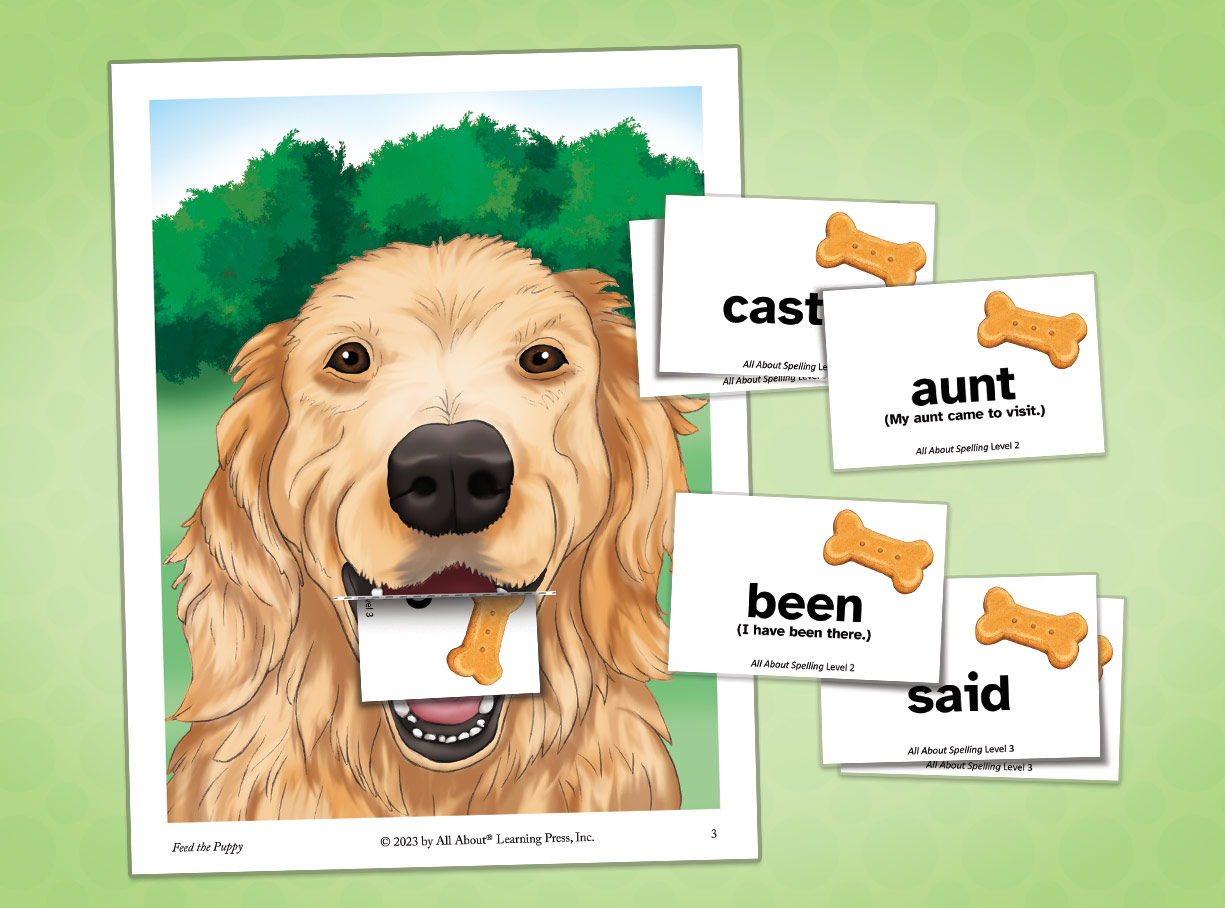
I dictate the new spelling words and several sentences that contain the spelling words. After the dictation, I put the new Word Cards behind the Daily Review tab in the Spelling Review Box so we can review them tomorrow.

Word Cards

All About Spelling has a philosophy of “we don’t just teach it and forget it,” which I totally appreciate. I mean, after I put in the time to teach my kids something, I want to make sure that they remember it later, and that’s where the built-in review really helps.

Day 3: Reinforcement

We review older flashcards with just a couple of the new ones mixed in, because I like to spread the new ones out over a few days. Then we quickly review the new concept we’ve been studying, followed by reinforcement words from the More Words section and more of the dictation exercises. If my kids miss any of the reinforcement words, I make Word Cards for them and put them behind the Daily Review tab.

Day 4: Writing Station

Here’s where we fit in the Writing Station activity (which starts in Level 3 of the program.)

In the Writing Station, students make up their own sentences with words that are dictated to them. Sometimes my kids like to make a little story using the words, sometimes they try to be funny, and sometimes they try to squeeze all the words into just one sentence! Here’s one that my daughter wrote:

This exercise makes a nice bridge between dictation and longer writing assignments that kids will do outside of spelling. I love how AAS gradually prepares kids for writing.

Day 5: Wrapping Things Up

Whatever we don’t get done on Days 1-4, we complete on Day 5.

If my children misspelled words in the dictation exercises during the week, I tucked those Word Cards behind the Review divider. If any concept needs to be re-taught, now’s the time to do it before we move on to the next step of the program. All About Spelling is mastery-based, so if my kids are confused about something, we fix it before moving ahead to the next lesson.

So that’s our typical week with All About Spelling. You may go faster or slower depending on your child’s needs and ability…and that’s the beauty of using a fully customizable program!

What about you? Are your days with AAS similar to mine? 


I had this great idea to explain the five reasons for Silent E. I took my camera out to the horse barn to visit Kjarkur and Oskar, my Icelandic horses, in their warm winter woolies.

This is Kjarkur (pronounced Kee-yar-kur). He’s a sweetie. I thought he could help me explain the Silent E in words like love and thick mane and snuggle bug.

Doesn’t he look sweet and cooperative?

Read On »

My Italian husband and I share a love of language and grammar and often amuse ourselves by conjugating verbs and doing other nerdy things that help each of us learn the other’s language better.

One of the stickier points, of course, is pronunciation. Although Italian grammar is more difficult overall, one good thing about the language is that every letter in a word is pronounced, and there’s usually just one or two ways to say each letter or group of letters. That’s why people look at me funny when I say “How do you spell that?”—because the words are, indeed, spelled exactly how they sound.

Read On »

One of my greatest pleasures is gardening.

I have a beautiful perennial garden, and all my plants have wonderful copper labels. I choose copper labels because they age nicely. You use a ballpoint pen to write on the soft copper, and the pressure from the pen leaves an imprint in the label.

This summer I added snowdrop anemones to my garden. As always, after I planted the flowers, I pulled out a copper label and a ballpoint pen. I said the name aloud as I wrote it on the label: “A-nen-o-me.”

Read On »

Learning to ride horses and becoming a student again has been an interesting experience. Each week, I get to see things from the viewpoint of a learner (often, a struggling learner!).

Growing up, I had a pony named Taffy. I rode her bareback, bitless and fearless. I learned early on to grip with my legs, because it was a survival skill—you grip or you fall off. Taffy was headstrong, too, and I was only eight years old and I’d never had a lesson. If Taffy got it into her head to make a run for the stables, all I could do was grab a handful of mane, grip with my short legs, and hang on tight.

Read On »

Ideal Game for Expanding Vocabulary

The first time I played Apples to Apples at a friend’s party, I knew I wanted to get this game for our next family gathering. Apples to Apples has become one of our favorite games, and it’s the one we pull out when we have guests with a wide range of ages and interests. A great side benefit is that playing this game is a wonderful way to expand your child’s vocabulary!

Apples to Apples is very simple to play. All you need are the game cards, a table to play on, and a group of people.

Read On »

My knife sliced easily through the packing tape with a pleasing little fsssss. The rrrrrip of cardboard. A flurry of packing peanuts. Soft breaths of anticipation.

And there it was: the glossy cover of All About Spelling, the fruit of my very first editing labor for Marie Rippel. It was lovely.

I settled in to admire our handiwork, eagerly flipping through the pages, already excited to share the book with my fa…GACK!

I saw it mid-flip. It was hard to miss, after all, accompanied as it was by flashing red lights and wailing sirens.

“Cut out the bars of the Jail so the Rule Breakers can peak through.”

Read On »

I take riding lessons at a nearby horse stable.

The stable is a magnet for young girls, and the place is always full. One day I counted eight girls—they were sweeping the barn, hosing down the horses, and cleaning tack.

They weren’t there for lessons. They were there because they couldn’t stay away. They wanted to be there, they were working—and they were loving it.

Read On »